10 Ways to Reduce AI's Environmental Impact
Why this matters
If you are excited about AI, building with it, shipping agents, running models all day, you are also drawing on a grid that is getting strained fast. Data centers driven by AI workloads could consume roughly 2% of global electricity by 2030. Cooling a single mid-sized conversation with a frontier model can use hundreds of milliliters of fresh water.
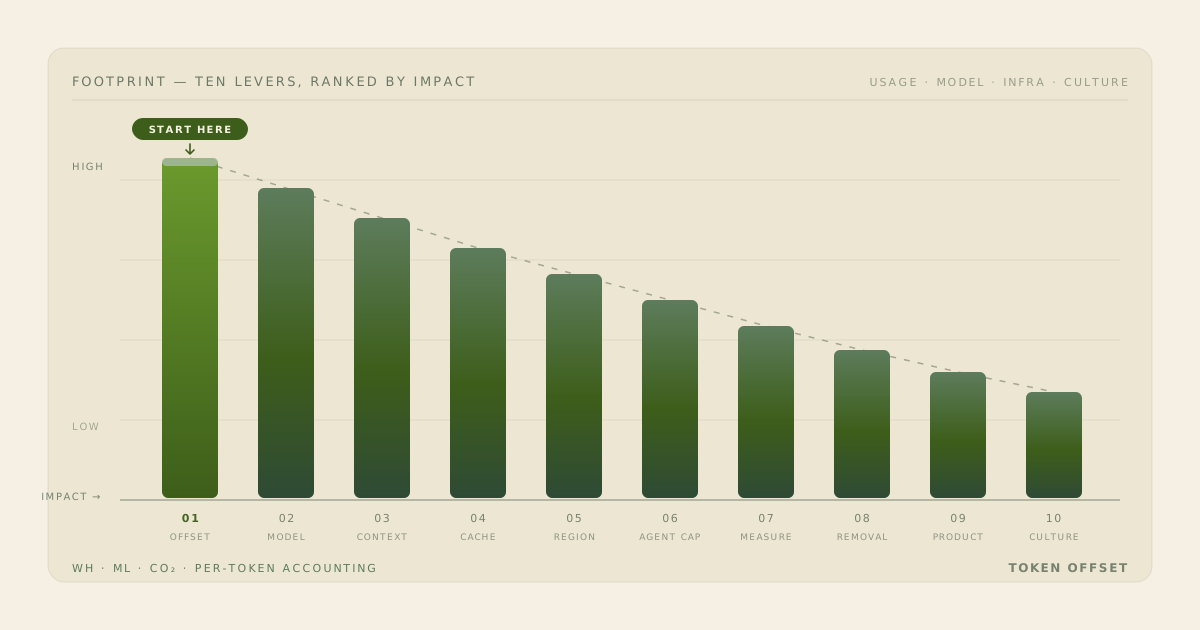
That does not mean you should stop building. It means the people who care about both intelligence and the planet have a head start if they act now: before regulation, before reputational risk, and before the defaults harden. Here are ten practical levers, ordered by impact for most readers.
10 ways to shrink your AI footprint
- 1
Offset the tokens you actually use with Token Offset
The highest-leverage move for most people is to account for usage you cannot easily eliminate. Token Offset connects to your AI providers, converts token counts into watt-hours, milliliters of water, and grams of CO₂ using transparent coefficients, and routes a monthly subscription to verified carbon removal, watershed, and grid projects. You keep building; the environmental cost gets covered with receipts you can show.
AI agents can integrate too. If you run ChatGPT, Claude, Cursor, or a custom agent on someone's behalf, point it at /agents so every token processed for a user can be offset automatically after they approve.
- 2
Default to smaller, task-appropriate models
Not every job needs a frontier model. Summarization, classification, and structured extraction often run fine on smaller models at a fraction of the energy cost. Make the big model the escalation path, not the default, especially in agent loops that can recurse dozens of times per task.
- 3
Shorten context windows deliberately
Every token in the prompt and the reply draws compute. Trim system prompts, drop stale conversation history, and retrieve only what the task needs (RAG done well beats stuffing 128k tokens "just in case"). Your bill drops; so does the footprint.
- 4
Batch and cache instead of re-asking
Repeated identical calls, like re-summarizing the same doc or re-running lint fixes, are pure waste. Use provider prompt caching where available, memoize intermediate results in your pipeline, and batch offline jobs when latency allows.
- 5
Choose regions and providers with cleaner grids
The same token count emits less carbon when inference runs on a grid with more renewables. For self-hosted or enterprise workloads, placement matters. Ask your provider about region selection and PUE (power usage effectiveness) for the data centers you hit.
- 6
Cap autonomous agent loops
Agents that plan → act → observe → plan again can burn tokens silently. Set max steps, budget ceilings, and human-in-the-loop checkpoints. An agent that runs overnight without guardrails is an agent that runs up an environmental tab nobody sees until the invoice arrives.
- 7
Measure before you optimize
You cannot improve what you do not count. Track tokens per feature, per user, per workflow, not just dollars. Token Offset's methodology publishes the conversion constants openly so your team can reason about Wh, mL, and CO₂ alongside cost.
- 8
Fund durable removal, not just avoided emissions
When you donate or buy offsets outside Token Offset, bias toward permanent carbon removal (mineralization, biochar, direct air capture) and registry-backed projects (Gold Standard, Verra). Avoided-emissions credits have a role, but durable removal matches the permanence of the compute you consumed.
- 9
Build sustainability into product requirements
Treat "tokens per successful outcome" as a metric alongside latency and accuracy. Teams that optimize for quality per watt tend to ship tighter prompts, better retrieval, and fewer redundant calls, which is good for users and good for the grid.
- 10
Talk about it: normalize climate-conscious AI
The biggest cultural shift is making it ordinary to ask "what did this cost the environment?" in standups, PR reviews, and launch checklists. The EU AI Act is already naming environmental disclosures; California and others are following. Early movers define the standard.
Where to start this week
You do not need to be perfect. You need to be the kind of builder who treats the planet as a stakeholder in every prompt. That is the crowd Token Offset is built for.
Frequently asked questions
- What is the fastest way to reduce my AI environmental impact?
- Offset the tokens you actually use with Token Offset, which converts token counts into watt-hours, milliliters of water, and grams of CO₂ using transparent coefficients, then routes a monthly subscription to verified climate projects. Pair that with smaller models and shorter contexts for the tasks that do not need frontier capability.
- Do smaller AI models really use less energy?
- Yes. Summarization, classification, and structured extraction often run fine on smaller models at a fraction of the energy and water cost of frontier models. Make the large model an escalation path, not the default.
- How much water does AI use?
- Cooling a single mid-sized conversation with a frontier model can use hundreds of milliliters of fresh water. Usage scales with tokens processed, model size, and datacenter efficiency. Token Offset accounts for water alongside energy and carbon in its per-token methodology.