What One AI Prompt Costs in 2026: Energy, Water and Carbon
The numbers we have
Two years ago nobody outside the labs could say what a chatbot prompt cost the grid. Now we have a handful of real disclosures, and they are surprisingly small. They are also easy to misread, because each one draws the boundary in a different place.
- 1
Google: 0.24 Wh per median Gemini text prompt
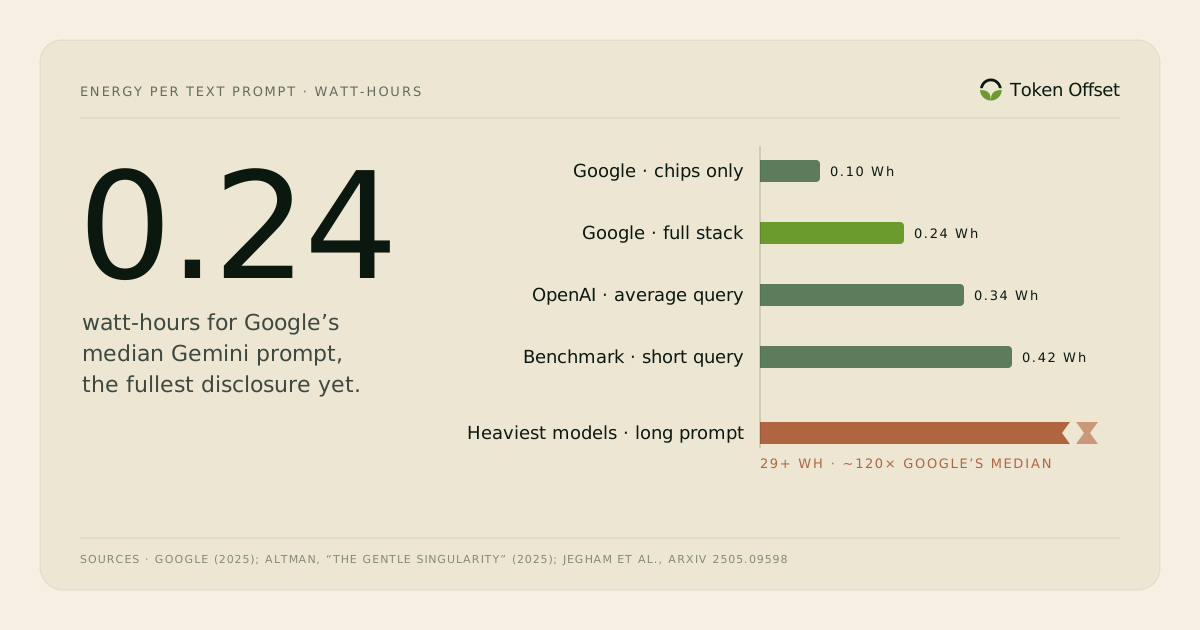
The most rigorous figure so far. Google measured its production fleet in May 2025 and counted the AI chips (58% of the total), host CPUs and memory (25%), idle machines held in reserve (10%) and data center overhead (8%). The same prompt cost 0.03 g of CO₂e and 0.26 mL of water, about five drops. Google also reported a 33-fold drop in energy per prompt over the prior 12 months.
- 2
OpenAI: 0.34 Wh per average ChatGPT query
Sam Altman wrote in June 2025 that the average query uses about 0.34 Wh, “about what an oven would use in a little over one second,” and about 0.000085 gallons of water. No methodology came with it, so we cannot say what is inside the boundary. Independent estimates land nearby: Epoch AI put a typical GPT-4o query at about 0.3 Wh.
- 3
Mistral: a full life cycle, per response
Mistral's peer-reviewed life cycle assessment skipped watt-hours and went straight to impacts: 1.14 g CO₂e and 45 mL of water for a 400-token Le Chat response, counting hardware manufacturing and the water used to make electricity. Training Mistral Large 2 cost 20.4 kilotons of CO₂e and 281,000 cubic meters of water.
- 4
Academic benchmarks: from 0.42 Wh to 29+ Wh
Jegham and colleagues benchmarked 30 models running in commercial data centers. A short GPT-4o query came in at 0.42 Wh. The most energy-intensive models exceeded 29 Wh on a long prompt, more than 65 times the most efficient systems they tested.
Energy per text prompt, by who's counting
Watt-hours per prompt. Long prompts on the heaviest models (29+ Wh) are off this scale.
Google, chips only
Narrow boundary
Google, full stack
Median Gemini prompt
Epoch AI estimate
Typical GPT-4o query
OpenAI
Average ChatGPT query
Benchmark
Short GPT-4o query
Sources: Google 2025 · Altman 2025 · Epoch AI · Jegham et al. 2025
View the data
| Source | What it covers | Wh per prompt |
|---|---|---|
| Google (chips only) | Active AI accelerators, efficient fleet | 0.10 |
| Google (full stack) | Chips, host, idle, overhead; median Gemini prompt | 0.24 |
| Epoch AI | Estimate, typical GPT-4o query | 0.30 |
| OpenAI | Average ChatGPT query, no methodology | 0.34 |
| Jegham et al. | Short GPT-4o query, benchmark | 0.42 |
| Jegham et al. | Long prompt, most energy-intensive models | 29+ |
Why the numbers disagree
A nearly 300-fold spread looks alarming, but four choices explain most of it.
- 1
Where the boundary sits
Google showed this directly: counting only active chips in its most efficient data centers gives 0.10 Wh; counting the whole serving stack gives 0.24 Wh, 2.4 times as much for the same prompt on the same hardware. Any figure that only measures the GPU understates the bill.
- 2
How long the prompt and answer are
A median chatbot prompt is short. Paste in a long document, or let a coding agent replay a 100,000-token context on every step, and energy climbs with it. That is why the long-prompt benchmark lands two orders of magnitude above the median.
- 3
Whether the model thinks out loud
Reasoning modes write long hidden chains of thought before they answer. Across 14 open models, reasoning answers averaged 544 tokens against 38 for concise ones, and the AI Energy Score project found reasoning modes used about 30 times the energy on average.
- 4
Median versus average
Google reports a median; OpenAI says average. With a long tail of heavy prompts, the average sits well above the median. Neither is wrong, but they answer different questions: “what does a typical prompt cost” versus “what does all this usage cost, divided by prompts.” For your own footprint, the second one is the one that adds up.
Water and carbon multiply the confusion
Water figures span even wider, from Google's 0.26 mL to Mistral's 45 mL, because of one choice: whether to count water evaporated at the power plant. On-site cooling is the only part most companies report. A 2023 UC Riverside study that added power-plant water estimated about 500 mL for every 10 to 50 medium-length GPT-3 responses, or 10 to 50 mL each, with the range driven by where and when the model ran.
Water per prompt depends on what you count
Milliliters per prompt or response. Counting the water used to generate electricity is what moves the number.
On-site cooling only
OpenAI
Boundary not stated
UC Riverside, low end
Cooling + power plant
Mistral
Full life cycle
UC Riverside, high end
Cooling + power plant
Sources: Google 2025 · Altman 2025 · Li et al. 2023 · Mistral 2025
View the data
| Source | Boundary | mL |
|---|---|---|
| On-site cooling, median Gemini prompt | 0.26 | |
| OpenAI | Average ChatGPT query (0.000085 gal) | ≈0.32 |
| Li et al. (low end) | Cooling + power plant, GPT-3 response | 10 |
| Mistral | Full life cycle, 400-token response | 45 |
| Li et al. (high end) | Cooling + power plant, GPT-3 response | 50 |
Carbon has its own fork. Google's 0.03 g is market-based: it nets out the renewable electricity Google buys. A location-based figure uses the actual mix on the local grid at that hour, which is usually higher, sometimes much higher. Both are legitimate accounting standards. Compare like with like, and be skeptical of any per-prompt carbon figure that does not say which one it uses.
How Token Offset counts
Token Offset prices usage per token, not per prompt, because tokens are what your provider bills and what scales with long contexts, reasoning and agents. Our current coefficients, from the methodology page, are:
Token Offset coefficients, per 1,000 tokens
A blended midpoint across input, cached and output tokens, deliberately set toward the conservative end of the published evidence.
0.50 Wh
Energy
Near Google's and Epoch's per-prompt figures for a typical exchange
3 mL
Water
On-site cooling plus a conservative share of power-plant water
0.6 g
CO₂e
Rounded up toward life cycle results like Mistral's
Source: Token Offset methodology
So a typical 1,000-token exchange is costed at about 0.5 Wh, 3 mL of water and 0.6 g of CO₂e. That sits above Google's median on purpose. We include water from power generation, we use grid-average rather than market-based carbon, and we would rather overpay for a footprint than underpay for it. When a lab publishes better data, we revise the constants and say so.
Frequently asked questions
- How much energy does one AI prompt use?
- Google measured 0.24 Wh for its median Gemini Apps text prompt in May 2025, counting chips, host servers, idle capacity and data center overhead. OpenAI's CEO cited 0.34 Wh for an average ChatGPT query. Long prompts on the most energy-intensive models can exceed 29 Wh, according to a 2025 benchmark of 30 models.
- How much water does an AI prompt use?
- Google reports 0.26 mL of on-site cooling water per median Gemini prompt, and OpenAI cites about 0.000085 gallons (0.32 mL) per ChatGPT query. Counting water consumed to generate the electricity and make the hardware raises that sharply: Mistral's life cycle assessment found 45 mL for a 400-token response.
- Why do AI energy estimates disagree so much?
- They measure different things. Some count only the AI chips; others include servers, idle machines and cooling. Prompt length and reasoning change energy by orders of magnitude, and carbon depends on whether a company uses market-based accounting with renewable purchases or the location-based mix of the local grid.