Voters Said No to Data Centers in the 2026 Midterms. What Now for AI?
What was on the ballot
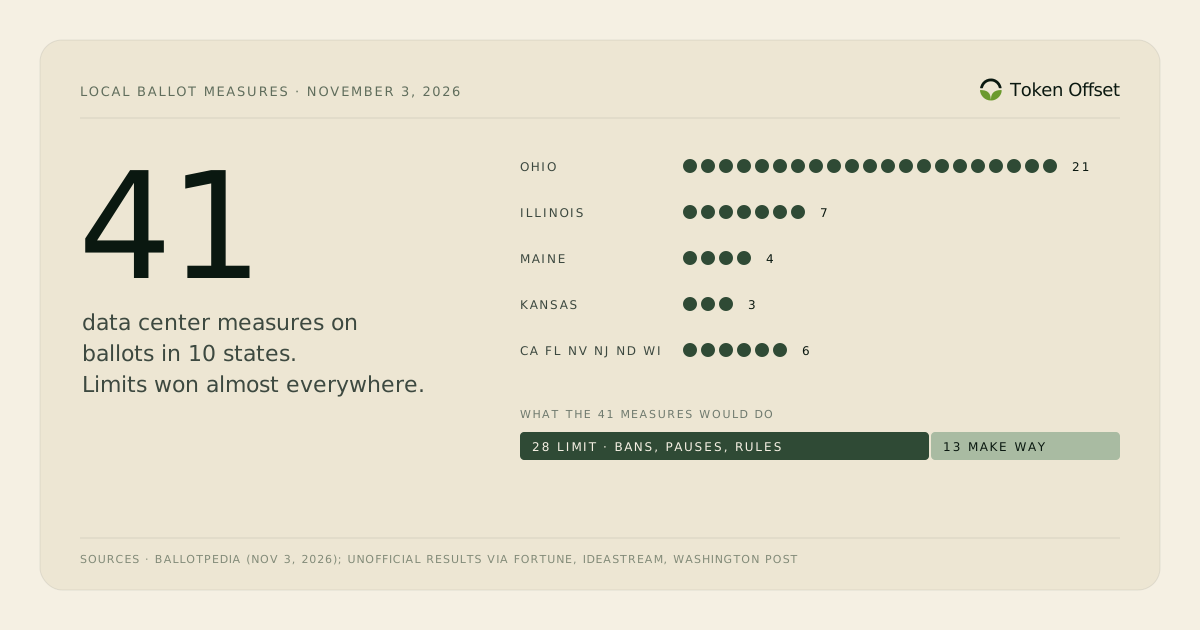
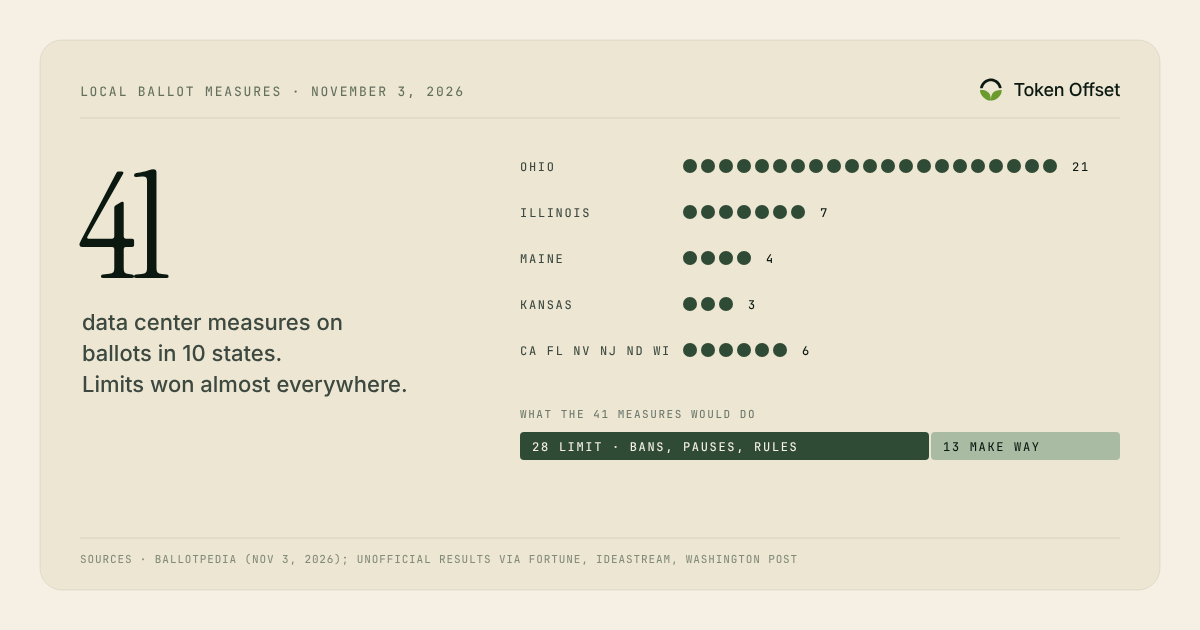
For two years the fight over AI data centers happened in zoning hearings and township meetings. On November 3 it reached the ballot box. Ballotpedia counted 41 local data center measures in 10 states, more than half of them in Ohio. Twenty-eight would limit data centers and thirteen would make way for them.
The limits came in several flavors. Seventeen were bans: twelve on facilities above a size threshold (usually 25 megawatts, which rules out hyperscale campuses while sparing small enterprise server rooms) and five on data centers outright. Three were six-month moratoriums, two required a public vote on big projects, and one, in Perry, Ohio, tied tax breaks to financial guarantees for the village. On the other side sat rezonings, a town agreement with a developer, and non-binding questions asking whether voters supported specific projects.
41 local measures, one dot each
Data center measures on November 3, 2026 ballots, by state, and what they would do.
Ohio
Illinois
Maine
Kansas
Six other states
Source: Ballotpedia
View the data
| State | Measures |
|---|---|
| Ohio | 21 |
| Illinois | 7 |
| Maine | 4 |
| Kansas | 3 |
| California, Florida, Nevada, New Jersey, North Dakota, Wisconsin | 1 each |
| Would limit data centers | 28 |
| Would facilitate data centers | 13 |
This was not the first test. Six data center measures were decided earlier in 2026, and the restrictive side won every one, mostly by landslides.
Before November, the restrictive side was 6 for 6
Share of the vote for the side that limited data centers in 2026's earlier local elections.
Nottingham, NH
Permitting moratorium
Augusta Township, MI
Rezoning defeated
Monterey Park, CA
Ban
Wrightstown, WI
Support measure defeated
Canterbury, NH
Ban
Port Washington, WI
Voter approval for tax districts
Source: Ballotpedia
View the data
| Place (date) | Measure | Restrictive side |
|---|---|---|
| Nottingham, NH (Sept. 8) | One-year permitting moratorium approved | 90.3% |
| Augusta Township, MI (Aug. 4) | Data center rezoning defeated | 89.6% |
| Monterey Park, CA (June 2) | Ban approved | 88.3% |
| Wrightstown, WI (Aug. 11) | Pro-data center advisory defeated | 87.3% |
| Canterbury, NH (Mar. 10) | Ban approved | 83.6% |
| Port Washington, WI (Apr. 7) | Voter approval for big tax districts | 66.4% |
What passed
Unofficial counts show voters passed more than 20 measures to ban or restrict data centers. Ohio, the state with the most on the line, produced the clearest signal. At least 14 Ohio municipalities passed bans or restrictions, and all five central Ohio communities with data center measures voted against the projects.
- 1
Sunbury, Ohio: 25-megawatt cap
A charter amendment banning data centers of 25 megawatts or more appears to have passed with every precinct counted. It targeted a possible hyperscale Amazon project whose fate is now unclear.
- 2
Trenton, Ohio: ban, 80% to 20%
The ban passed four to one, though it may not reach a four-building AWS campus already under construction nearby. A ban written after construction starts usually only binds the next project.
- 3
Hubbard and Conneaut: bans reach Northeast Ohio
Hubbard passed a total ban with about 76% after residents learned the mayor had signed a non-disclosure agreement with a developer. Conneaut amended its charter to prohibit data centers over 25 megawatts by roughly two to one; residents organized after a statewide hyperscale ban fell short of the signatures it needed.
- 4
Perry, Ohio: pay to play, 87%
Rather than ban anything, Perry required developers seeking tax abatements to provide financial guarantees, plus size and noise limits. Other towns can copy it easily, and it is hard to campaign against a rule that only asks developers to guarantee what they promise.
- 5
Ashville and Monroeville: no to projects already in motion
Ashville voters rejected a town agreement for a data center campus already under construction. In Monroeville, 87% opposed an advisory question on allowing a proposed 100-megawatt facility.
The pattern extended to candidates. Heatmap's early read found that campaigns attacking data centers, over tax breaks, utility bills or candidates' stock holdings, largely won, including governor's races in Georgia, Ohio and Texas where the winners promised pauses or tougher rules. In Ohio's Senate race, Sherrod Brown, who wants to end data center tax breaks and make operators pay for the utilities they need, beat Sen. Jon Husted, who backed the breaks. Plenty else was on voters' minds, so treat any single race as suggestive rather than proof.
Why voters said no
The polling pointed this way for months. In May, Gallup found 7 in 10 Americans opposed an AI data center near them, 48% strongly, which is more opposition than Gallup measured for a local nuclear plant. A statewide Ohio poll found 55% opposed data center construction and 65% opposed tax breaks for it, with the environment as the top reason.
The numbers behind the backlash
70%
of Americans oppose an AI data center near them
Gallup, fieldwork March 2026
65%
of Ohioans oppose data center tax breaks
ICAPP/SurveyUSA, 1,650 adults
11×
rise in PJM capacity prices over two auctions
$28.92 to $329.17 per MW-day
833
local groups opposing data centers by spring 2026
Up from 396 at the end of 2025
Bills are the sharpest grievance. On PJM, the grid that serves 13 states from New Jersey to northern Illinois, the price utilities pay to keep enough generation on call rose from $28.92 per megawatt-day to $329.17 in two auctions, and PJM's independent market monitor attributed most of the increase to data center demand. The Union of Concerned Scientists found $4.3 billion in 2024 transmission projects built to connect data centers in seven PJM states, with more than 95% of those costs passed to all customers. We dig into the bill math in a follow-up post.
Water, noise, farmland and secrecy fill out the list. Hubbard's petitioners started organizing over an NDA. The industry, for its part, mostly stayed quiet: an Ohio pollster said he had never seen a pro-data center op-ed from the industry, even as an industry-linked group spent at least $2.54 million on Ohio TV ads that touted $40 billion of investment without asking for a vote either way.
What it means for the industry
The spending is not slowing down. Amazon, Microsoft, Alphabet, Meta and SpaceX are on track to spend $803 billion to $828 billion on capex this year, most of it for AI infrastructure. The votes change where that money lands and who pays for the grid behind it. Five shifts look likely.
- 1
Longer timelines
Data Center Watch tallied about $130 billion of projects blocked or delayed in the first quarter of 2026 and $68 billion more in the second. Ballot wins add a new kind of risk: a project can clear the planning board and still lose at the polls. Expect developers to price that in with longer timelines and community benefit agreements signed before a petition circulates.
- 2
The 25-megawatt line becomes a template
Size caps let towns keep ordinary server rooms while excluding hyperscale campuses that draw hundreds of megawatts. They are simple to draft and survived on ballots in Sunbury and Conneaut. Hyperscalers will probably concentrate in fewer places with spare power and local support, and pay more for those sites.
- 3
Pay-your-own-way rules spread
Regulators were already moving. Ohio approved an AEP Ohio tariff requiring new data centers above 25 megawatts to pay for at least 85% of their subscribed capacity for up to 12 years, and Texas SB 6 lets the grid operator curtail large loads in emergencies and charges them to study interconnection. Tuesday's results hand every governor and utility commission a mandate to copy those rules. If data centers pay their full grid costs, the bill argument against them gets much weaker.
- 4
More on-site gas, and an emissions problem
The fastest way around a crowded interconnection queue and an angry ratepayer is to build your own power plant. The IEA notes that on-site gas projects for data centers are largely a US phenomenon. Behind-the-meter gas sidesteps the bill fight but locks in fossil emissions unless operators commit to clean firm power or capture later.
- 5
Federal tax breaks are in play
Goldman Sachs strategists expect a Democratic Congress could curb data center tax incentives but see a nationwide moratorium as unlikely. The more realistic federal fights are over who pays for transmission and whether large loads must disclose their energy and water use.
What it means for AI users
Every prompt runs in a building somewhere, on a grid that local customers pay to expand. The towns that voted no on Tuesday mostly objected to tax breaks, higher bills and secrecy, and the polling says the same.
Token Offset works at the level of a single user. Connect your AI providers, see the energy, water and carbon behind the tokens you use, and fund climate work that covers them. Our methodology is public, so you can check the math.
To shrink your share before you pay for it, our guide to reducing AI's environmental impact ranks ten changes, from smaller models to shorter contexts. For what OpenAI, Anthropic, Google, Meta and Microsoft report about their own energy and water use, read what frontier AI labs are doing about environmental impact.
Frequently asked questions
- How many data center measures were on the ballot in November 2026?
- Ballotpedia counted 41 local data center measures in 10 states on November 3, 2026: 21 in Ohio, 7 in Illinois, 4 in Maine, 3 in Kansas and one each in California, Florida, Nevada, New Jersey, North Dakota and Wisconsin. 28 would limit data centers and 13 would facilitate them.
- Did the data center bans pass?
- Mostly, yes. Unofficial results showed restrictions winning in the large majority of contests. In Ohio, at least 14 municipalities passed bans or restrictions, including 25-megawatt caps in Sunbury and Conneaut, an outright ban in Hubbard, an 80-20 ban in Trenton and an 87% vote in Perry requiring financial guarantees from developers seeking tax breaks. Results are unofficial until certified.
- Why are voters turning against data centers?
- Electricity bills, water, noise and land use top the list. Capacity prices in PJM, the grid serving 13 states, rose from $28.92 per megawatt-day to $329.17 in two auctions, and PJM's market monitor tied most of the increase to data center demand. Gallup found 7 in 10 Americans oppose an AI data center near them.
- What do the midterm results mean for the AI industry?
- Expect delays and higher costs rather than a halt. Hyperscalers are on track to spend roughly $800 billion on capex in 2026, but projects will move toward places with local consent and firm power, states will keep adding rules that make large loads pay for their own grid upgrades, and more developers will build on-site gas generation, which raises emissions unless it is cleaned up later.