Are AI Data Centers Raising Your Electric Bill? What the Data Shows
The short answer
In parts of the country, yes, and the mechanism is well documented. Nationally the effect is smaller than the headlines suggest, so far. The utility fights of the next few years will mostly be in the places where the local effect is large.
Some scale first. US data centers used about 176 terawatt-hours in 2023, 4.4% of the country's electricity. Lawrence Berkeley National Laboratory projects 6.7% to 12% by 2028. Globally, the IEA found data center demand grew 17% in 2025, with AI-focused facilities up 50%, and expects the total to roughly double by 2030. Most of that demand lands in a few dozen places, and someone has to pay for the plants and wires that serve it.
Where it shows up first: PJM's capacity market
PJM runs the grid for 13 states and Washington, DC, including Northern Virginia, the densest data center market on earth. Once a year it holds an auction to pay power plants to be available at peak. Every utility customer in the region pays the result.
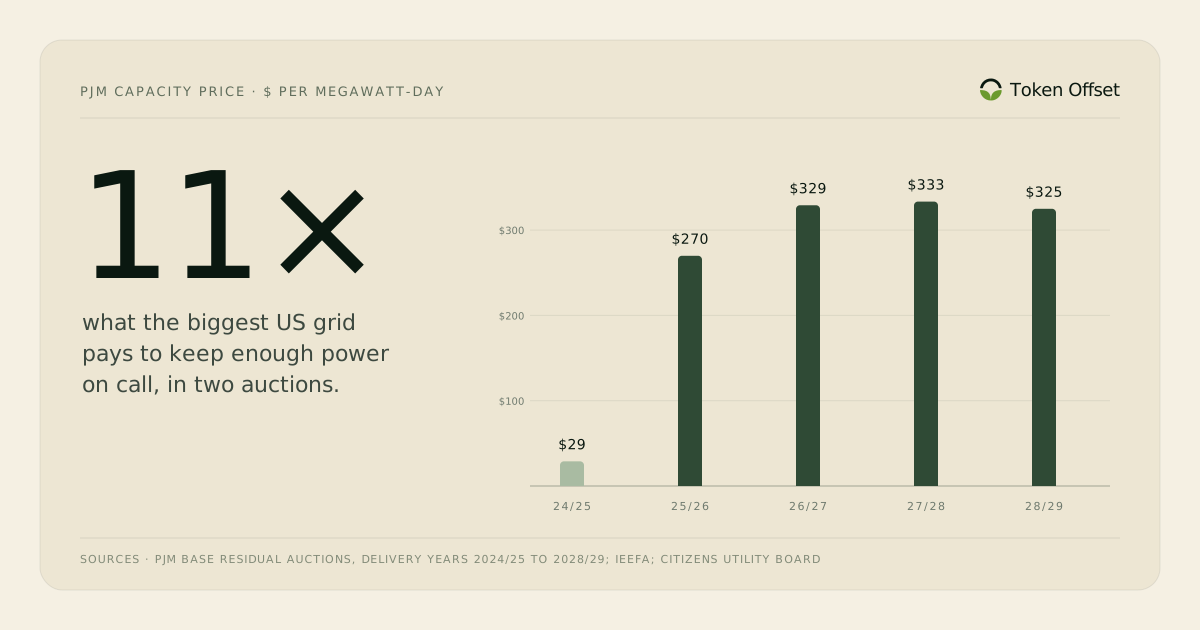
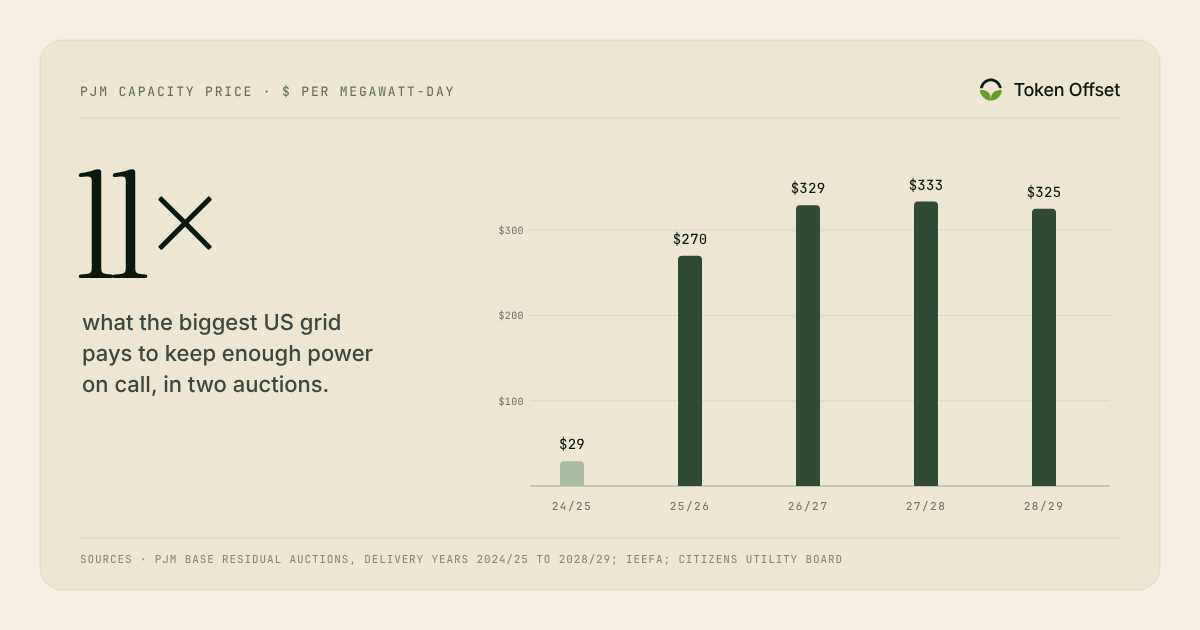
What PJM pays to keep power on call
Capacity auction clearing price, dollars per megawatt-day, by delivery year.
Sources: PJM via IEEFA · Voltus · Citizens Utility Board
View the data
| Delivery year | $ / MW-day |
|---|---|
| 2024/25 | 28.92 |
| 2025/26 | 269.92 |
| 2026/27 | 329.17 (at cap) |
| 2027/28 | 333.44 (at cap) |
| 2028/29 | 325.00 (at cap) |
The price jumped more than elevenfold in two auctions and has sat at a negotiated cap since. PJM's independent market monitor estimated that data centers were responsible for 63% of the 2025/26 increase, about $9.3 billion in higher customer costs. The December 2025 auction set a record $16.4 billion and still fell short of PJM's target reserve margin; PJM expects peak demand to grow 32 gigawatts from 2024 to 2030, all but 2 of them from data centers. The July 2026 auction cleared at the cap again, short of the reliability requirement for a second year.
What that means at the meter
+$16/mo
on the average Ohio residential bill from data-center-driven capacity costs
IEEFA; $18 in western Maryland
18.2¢
average US residential price per kWh expected in 2026
EIA, nearly 5% above 2025
60%
upper end of ICF's estimate for PJM residential rate increases by 2030
Range: 30% to 60%
+$70/mo
possible rise in an average family's bill by 2028
NRDC analysis
Transmission costs
Then there are the wires. A hyperscale campus also needs new substations and high-voltage lines, and those costs usually land in the general rate base. The Union of Concerned Scientists found $4.3 billion in transmission projects approved in 2024 to connect data centers in seven PJM states. In more than 95% of the 130 projects, the full connection cost was passed to all customers.
Data center grid connections billed to everyone
Transmission connection projects for data centers approved in 2024, millions of dollars, by state.
Virginia
Ohio
Pennsylvania
Illinois
West Virginia
Maryland
New Jersey
Source: Union of Concerned Scientists
View the data
| State | $ millions |
|---|---|
| Virginia | 1,900 |
| Ohio | 1,300 |
| Pennsylvania | 491.7 |
| Illinois | 239 |
| West Virginia | 215.8 |
| Maryland | 107.5 |
| New Jersey | 14.5 |
The case that it's overblown
The best counterargument starts with fixed costs. Grids have a lot of them. Spread them across more kilowatt-hours and the price of each one can fall. Lawrence Berkeley National Laboratory looked at 2019 to 2024 and found that states with the fastest load growth saw average prices fall, while states with shrinking demand saw them rise. Replacing old poles and wires drove more of the increase than serving new load did.
A 2026 follow-up with the Brattle Group found real average prices in 2025 were up 3% from 2019 and down 6% from 2010, with electricity at about 1.25% of household spending, near an all-time low. The same work names PJM capacity prices as a major driver of rising bills in mid-Atlantic states.
How the rules are changing
Regulators have noticed, and the November ballot results gave them political cover to move faster.
- 1
Minimum-demand tariffs
Ohio approved AEP Ohio's data center tariff in July 2025: new facilities over 25 MW pay for at least 85% of the capacity they reserve for up to 12 years, whether they use it or not. Speculative projects that would have reserved grid capacity and walked away now carry the cost.
- 2
Curtailment in emergencies
Texas SB 6 requires new loads of 75 MW or more to install equipment that lets the grid operator disconnect them during blackout-level emergencies, adds interconnection study fees and disclosure rules, and sets terms for pairing data centers with existing plants.
- 3
Price caps and separate rate classes
PJM's capacity cap, pushed by Pennsylvania Gov. Josh Shapiro, is now extended through 2030. Expect more states to put large loads in their own rate class so their costs can be tracked separately. In an October Consumer Reports survey cited by Yahoo News, 84% of people supported exactly that.
What you can do
If you live in a data center region, show up when your utility commission takes comments on large-load tariffs. These dockets decide who pays, and a resident's comment goes on the record. If you build with AI, push your providers to say where your workloads run and whether those facilities pay their own grid costs.
And account for your share. Every token you use draws on a grid somebody is paying to expand. Token Offset turns your real usage into energy, water and carbon estimates and funds climate work to cover them.
Frequently asked questions
- Are data centers raising electricity prices?
- In some places, yes. In PJM, which serves 13 states and DC, capacity prices rose from $28.92 per megawatt-day for 2024/25 to $329.17 for 2026/27, and PJM's independent market monitor attributed most of the increase to data center demand. Nationally the picture is mixed: LBNL found that states with faster load growth saw lower average prices from 2019 to 2024, though that may not hold under today's growth.
- How much will data centers add to my bill?
- It depends on your utility. IEEFA estimated PJM capacity costs tied to data centers add roughly $16 a month to the average residential bill in Ohio and $18 in western Maryland. EIA expects US residential prices to average 18.2 cents per kWh in 2026, nearly 5% above 2025.
- What are states doing to make data centers pay their own way?
- Ohio regulators approved an AEP Ohio tariff requiring new data centers above 25 MW to pay for at least 85% of their subscribed capacity for up to 12 years. Texas SB 6 lets the grid operator curtail large loads of 75 MW or more in emergencies and adds interconnection fees and disclosure rules. Dozens of other states have similar bills.