How Much Water Does AI Use? The Part You See and the Part You Don't
Two kinds of water
“AI drinks a bottle of water per conversation” and “a prompt uses five drops” are both repeated constantly, and both can be defended. The difference is which water you count.
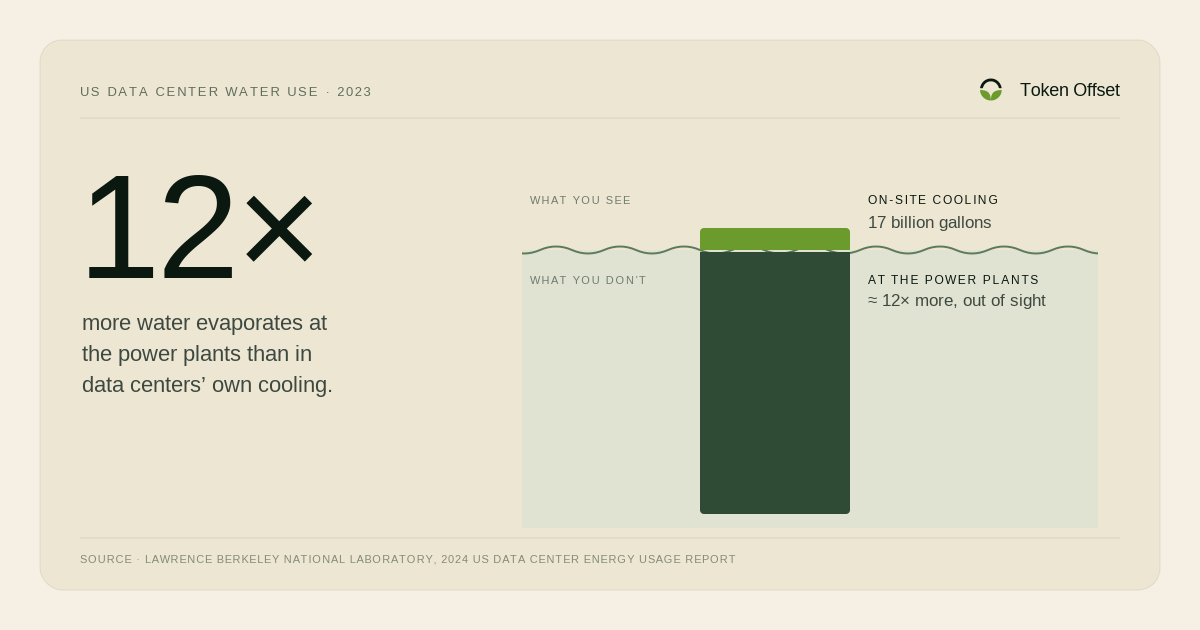
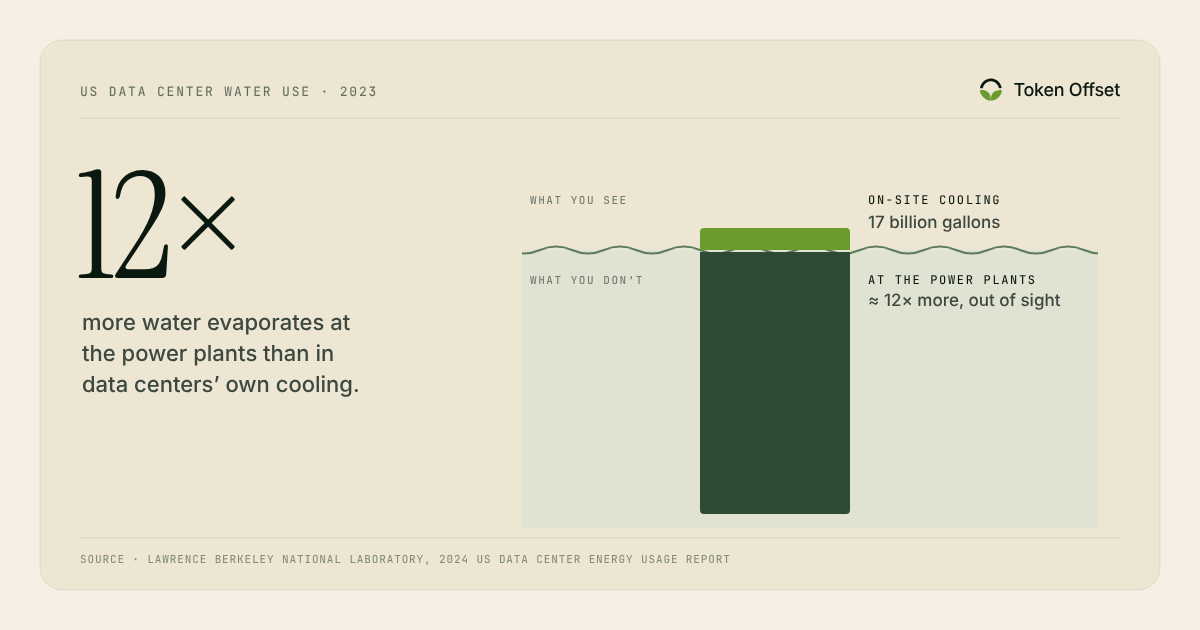
Direct water is what a data center consumes on site, mostly evaporated in cooling towers to carry heat away from servers. Indirect water is consumed upstream, at the power plants generating the electricity, where thermal plants evaporate water to cool their own condensers. Lawrence Berkeley National Laboratory estimated that US data centers directly consumed 17 billion gallons of water in 2023, and the indirect footprint was about 12 times larger. Both could double by 2028.
Withdrawal is water taken from a river or aquifer, some of which is returned. Consumption is the part that is not returned, mostly because it evaporated. Consumption is the better measure of what a watershed loses.
AI's water at a glance
17B gal
consumed directly by US data centers in 2023
Lawrence Berkeley National Laboratory
12×
more consumed at the power plants feeding them
Indirect vs. direct, same report
+34%
rise in Google's water consumption in 2025
To 10.9 billion gallons
67%
of new US data centers since 2022 sit in high water-stress areas
About two-thirds, per Bloomberg
Sources: LBNL via Latitude Media · Google 2026 report · Bloomberg
What the companies report
Disclosure is better than it was, though still mostly direct water only.
- 1
Google: 10.9 billion gallons, up 34%
Google's 2026 environmental report puts 2025 water consumption across data centers and offices at 10.9 billion gallons, up 34% from 2024. It replenished about 7.7 billion gallons through watershed projects, roughly 78% of its freshwater consumption by its own accounting, against a goal of 120%.
- 2
Amazon: 2.5 billion gallons, first disclosure
Amazon reported data center water use for the first time in June 2026: 2.5 billion gallons in 2025, at about 0.03 gallons per kWh. It says 26 data centers run on reclaimed water and that it “returned” about two-thirds of its use, largely by funding local water infrastructure.
- 3
Microsoft: designing water out of cooling
Microsoft reports average water usage effectiveness of 0.30 liters per kWh, and says new data center designs from August 2024 onward use closed-loop, chip-level cooling that avoids more than 125 million liters of water per facility per year, with pilots in Phoenix and Mount Pleasant, Wisconsin.
Water per unit of electricity, as reported
On-site water usage effectiveness (WUE), liters per kWh. Lower means less cooling water per unit of computing.
Microsoft
Fleet average, reported
Amazon (AWS)
0.03 gal/kWh, converted
Sources: Microsoft via ESG News · Amazon via Latitude Media
View the data
| Company | Reported WUE | Liters per kWh |
|---|---|---|
| Microsoft | 0.30 L/kWh | 0.30 |
| Amazon (AWS) | 0.03 gal/kWh | ≈0.11 |
Company figures are not perfectly comparable: climates, cooling designs and reporting boundaries differ, and only Meta among the big operators reports indirect water. WUE is most useful for tracking one company over time; ranking companies with it is shaky.
Why place beats totals
Seventeen billion gallons sounds enormous, and it is small next to US agriculture or thermoelectric power. The national total hides where the water comes from: a gallon pulled from a stressed aquifer in the desert Southwest costs a community far more than a gallon from the Great Lakes.
Bloomberg found that about two-thirds of the US data centers built or in development since 2022 are in areas of high water stress, and five states account for 72% of those. Developers want cheap land and good power, and in the US a lot of that sits in dry places. Looking ahead, the UC Riverside team projected that global AI could withdraw 4.2 to 6.6 billion cubic meters of water in 2027, comparable to four to six Denmarks.
So how much water is one prompt?
On-site only, very little: Google measures 0.26 mL for a median Gemini text prompt. Add power-plant water and hardware, and Mistral's life cycle assessment reaches 45 mL for a 400-token response. The UC Riverside estimate of about 500 mL per 10 to 50 GPT-3 responses sits in between. The “bottle per conversation” line comes from that study, and it holds only if you count upstream water and a long conversation. We walked through the per-prompt numbers in detail in What One AI Prompt Costs.
What helps
- 1
Basin-level disclosure
Ask providers for water use by facility and watershed, including indirect water, not a global total netted against replenishment projects somewhere else.
- 2
Reclaimed and non-potable water
Cooling with treated wastewater instead of drinking water, as Amazon says 26 of its sites do, takes the sharpest edge off local competition for water.
- 3
Closed-loop cooling where water is scarce
Designs like Microsoft's make the most sense in stressed basins, paired with clean power so the extra electricity does not move the water problem to a coal plant.
- 4
Fewer, better tokens
Every token avoided saves water on site and at the power plant, so smaller models, shorter contexts and capped agent loops all cut water use.
Token Offset counts water alongside energy and carbon, including a conservative share of power-plant water, and routes part of every contribution to watershed restoration.
Frequently asked questions
- How much water do AI data centers use?
- Lawrence Berkeley National Laboratory estimated US data centers directly consumed about 17 billion gallons of water in 2023, mostly for cooling, and that the water consumed generating their electricity was about 12 times larger. Google alone consumed 10.9 billion gallons across data centers and offices in 2025, up 34% from 2024.
- Does ChatGPT really use a bottle of water per conversation?
- It depends on what you count. On-site cooling for a single prompt is a fraction of a milliliter by Google's and OpenAI's figures. A 2023 UC Riverside study that also counted power-plant water estimated about 500 mL for every 10 to 50 medium-length GPT-3 responses, and Mistral's life cycle assessment found 45 mL per 400-token response.
- Why does data center location matter for water?
- Because water is local: a gallon withdrawn from a stressed aquifer in Arizona costs a community far more than one from the Great Lakes. Bloomberg found about two-thirds of US data centers built or in development since 2022 are in areas of high water stress.